Humpbacks, orcas and the rest
A Juneau whale trip is mostly about humpbacks, with orcas as the wild card and a supporting cast of smaller animals. Nothing on the water is promised. This guide covers what you are likely to see and how to recognize it, then how close the boats are allowed to go.
Humpbacks carry the show
Most of the whales you are likely to see from a Juneau boat in summer are humpbacks. They come north to feed on herring and krill, along with other small fish, in the cold channels around the city. Most of them spend the winter in Hawaii, where they breed, and return in spring. Many stay into the fall, and a few are thought to linger through the winter.
That steady summer presence is why several listings carry a whale guarantee. Harv & Marv's listing guarantees a sighting. Juneau Tours & Whale Watch makes the same promise between May 15 and September 15, and Viator lists a 100% guarantee on the Alaska Tales trip. None of these listings spell out what you get if the boat comes back without a whale, refund or rebooking, so ask before you book. A guarantee is a business promise, not a forecast, and whales keep their own schedule.
What a sighting usually looks like
Breaches make the brochures, but a typical encounter is quieter. The first sign is usually a blow, a column of misty breath that hangs in the air for a moment and shows from far off on calm water. The captain slows and heads that way. Then the whale's dark back rolls through the surface a few times as it breathes, with the small dorsal fin showing. Finally the back arches high and the tail lifts clear as the whale dives, often for several minutes, before it surfaces somewhere nearby.
On a two-hour cruise you may follow one whale through several of these cycles, or move between a few animals. Now and then a humpback breaches, throwing most of its body out of the water, or lies on its side and slaps a long white pectoral fin on the surface. Nobody can predict either. Watch the naturalist, since crews tend to spot the next blow before guests do, and our photography guide covers how to catch the fluke as it rises.
Bubble-net feeding
The behavior most guests hope for is bubble-net feeding. A group of humpbacks circles beneath a school of herring or krill and blows a ring of bubbles that works like a net, trapping the prey near the surface. Then the whales lunge up through the middle together with their mouths wide open, often with gulls wheeling overhead. It happens in these waters in summer, but seeing it from a tour boat is mostly luck. One Dolphin guest off a cruise ship watched it, and Alaska Tales calls it rare in its glacier listing. Treat it as a bonus rather than a reason to choose one boat over another.
Whales with names
The underside of a humpback's tail carries a pattern of black and white marks and scars that differs from whale to whale, much like a fingerprint. Naturalists photograph the fluke as the whale dives and match it against catalogs of known animals. Reviewers on Harv & Marv's trips and on the lighthouse tour say the crews name individual whales and know some of their histories, so a raised tail becomes a returning neighbor rather than an anonymous animal.
Harv & Marv's also gives the longest look at the water among the six tours we compare. Its whale cruise from ~$159 spends 3 hours afloat, against roughly 2 hours on most of the others, and picks you up at your cruise dock. The drawback is that Viator sells it as non-refundable. The operator offers another time or a full refund only when it cancels for weather.
Three hours to learn a whale's routine
Harv & Marv's keeps you on the water for 3 hours from ~$159, with pickup at your ship and departures nearly every half hour. Book only once your plans are firm, since the sale is final.
Orcas, the wild card
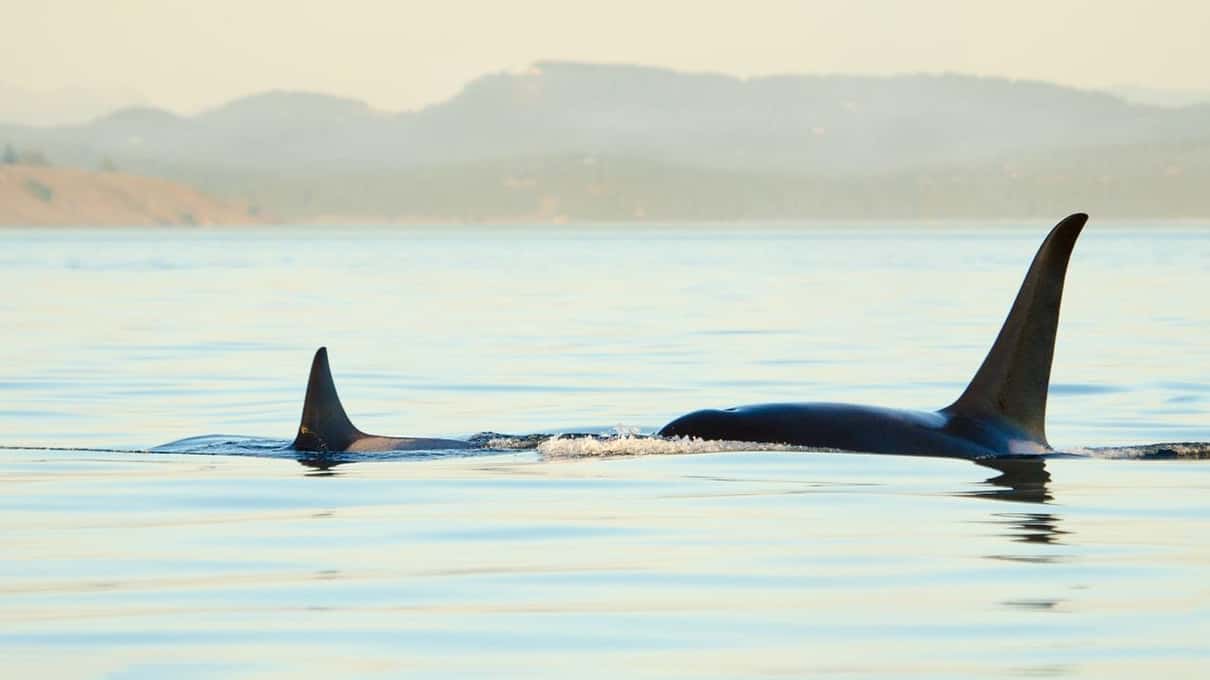
Orcas turn up on some Juneau trips and not on others. They can appear in any month, and nobody can forecast them. Reviewers on several different boats describe meeting a pod, and Alaska Tales guests say their crew stayed with the orcas for as long as the rules allowed. The tall black dorsal fin of an adult male is the giveaway, far taller and straighter than anything a humpback shows.
Scientists divide the orcas along this coast into types that live differently, and a naturalist may tell you which kind you are watching. Broadly, resident orcas eat fish such as salmon, while transient orcas (also called Bigg's orcas) hunt seals and other marine mammals and tend to travel quietly. Take that as a general pattern, since the crew on the day will know more than any guide page.
The rest of the cast
Whales are the headline, but most trips fill the gaps with smaller animals. The table gives a rough idea of how often each one shows up, based on the listings and what reviewers report. None of it is promised.
| Animal | How often | Where | What to look for |
|---|---|---|---|
| Humpback whale | Most summer trips, never certain | Open channels and feeding spots | A misty blow first, later the raised fluke |
| Orca | Some trips, any month | Anywhere, usually on the move | Tall black dorsal fins traveling together |
| Steller sea lion | Often | Benjamin Island, channel buoys | Large tan bodies piled on rocks, loud roaring |
| Harbor seal | Fairly often | Rocks and quiet water near shore | A round spotted head that watches, then sinks |
| Dall's porpoise | Now and then | Open water | Fast black and white bodies throwing a rooster-tail spray |
| Sea otter | Sometimes | Calm water near shore | A small head and paws, floating on its back |
| Bald eagle | Most trips | Shoreline spruce, pilings | A white head high in the trees |
| Black bear | Occasionally | Beaches and shoreline | A dark shape moving along the tide line |
| Minke or gray whale | Rare | Open water | Leave that call to the naturalist |
Sea lions are the safest bet after humpbacks. Alaska Tales mentions the haul-out on Benjamin Island, where Steller sea lions crowd the rocks, and others sprawl on navigation buoys in the channels. Minke and gray whales do pass through but rarely show on tours, so do not plan around them. If you want bears on land as well, the salmon streams near the glacier are the likelier place, which our glacier combo guide covers.
How close the boats go
Under federal rules, a boat in Alaska waters must stay at least 100 yards (91 m) from a humpback, and that applies to every operator, big boat or small. A smaller boat does not bring you any nearer by law, as our boat-size comparison explains. Whales do not read the rules, though. Sometimes a humpback surfaces beside a stopped boat on its own, and reviewers on more than one tour describe whales passing close by. Binoculars make a big difference at 100 yards, and Dolphin and the lighthouse boats hand them out.
Which animals are around also shifts through the summer, and the month-by-month guide follows that. If a rolling deck worries you more than a distant whale, start with our advice on seasickness before you book.